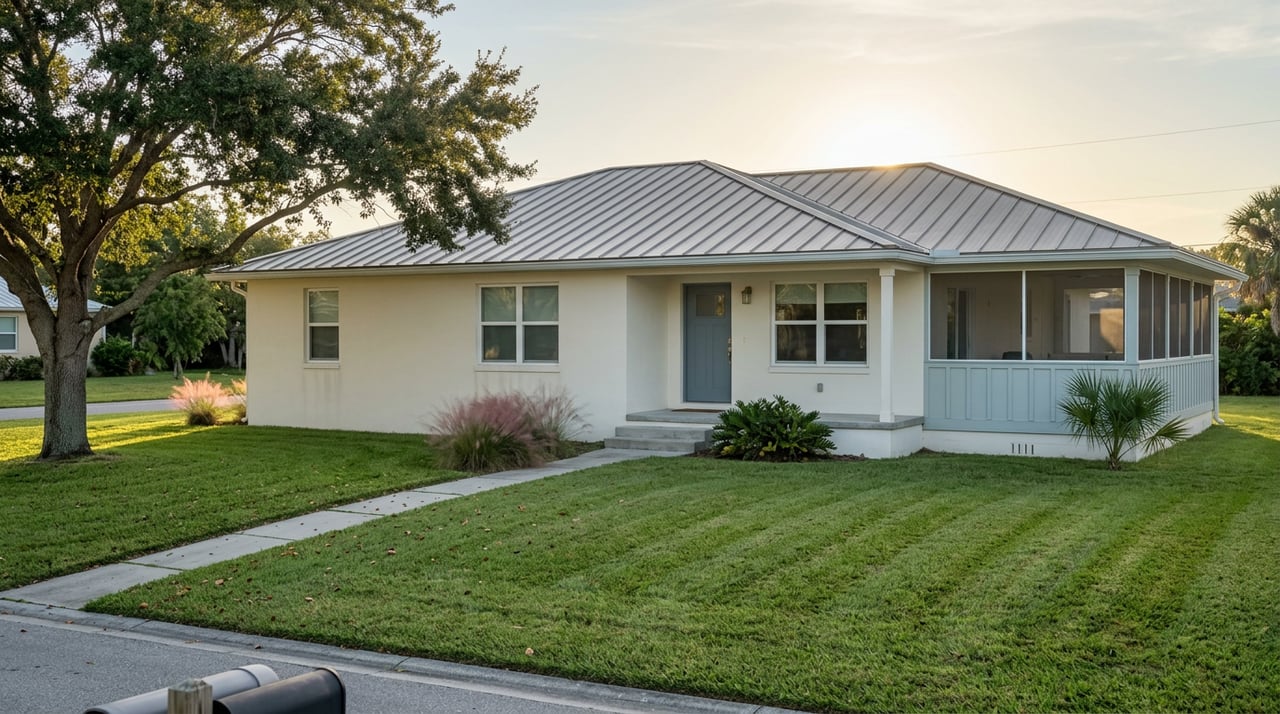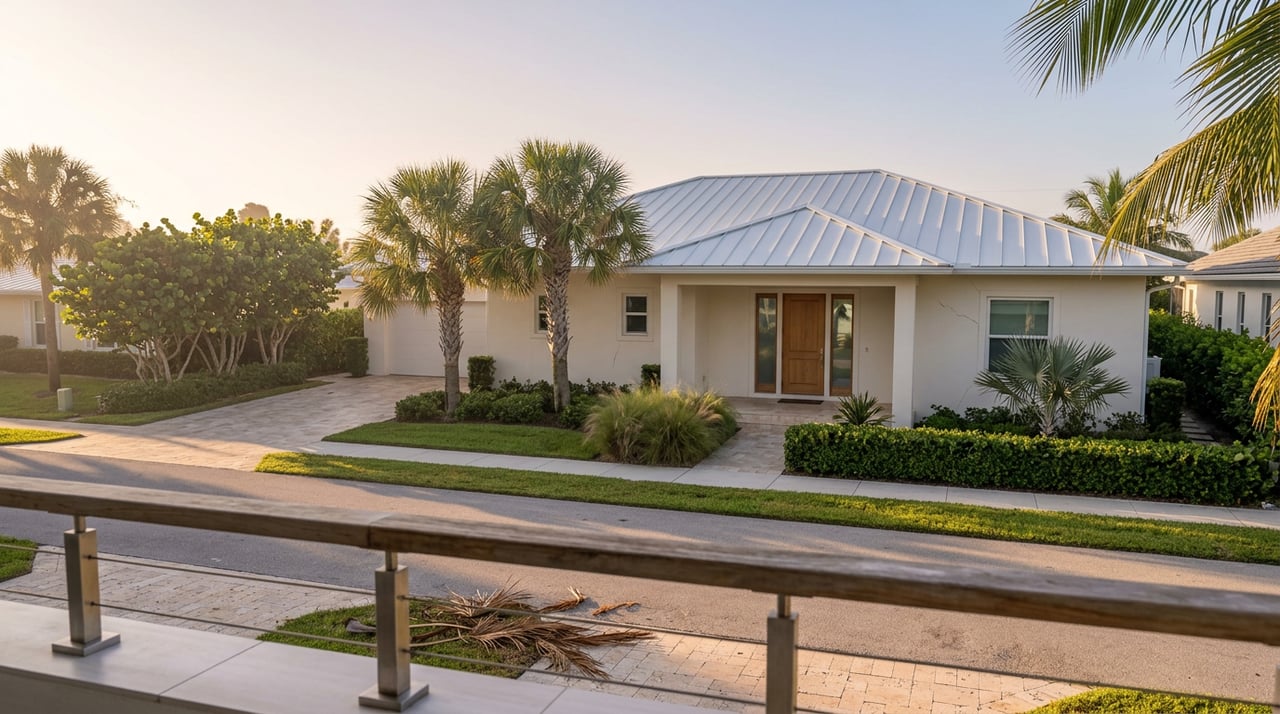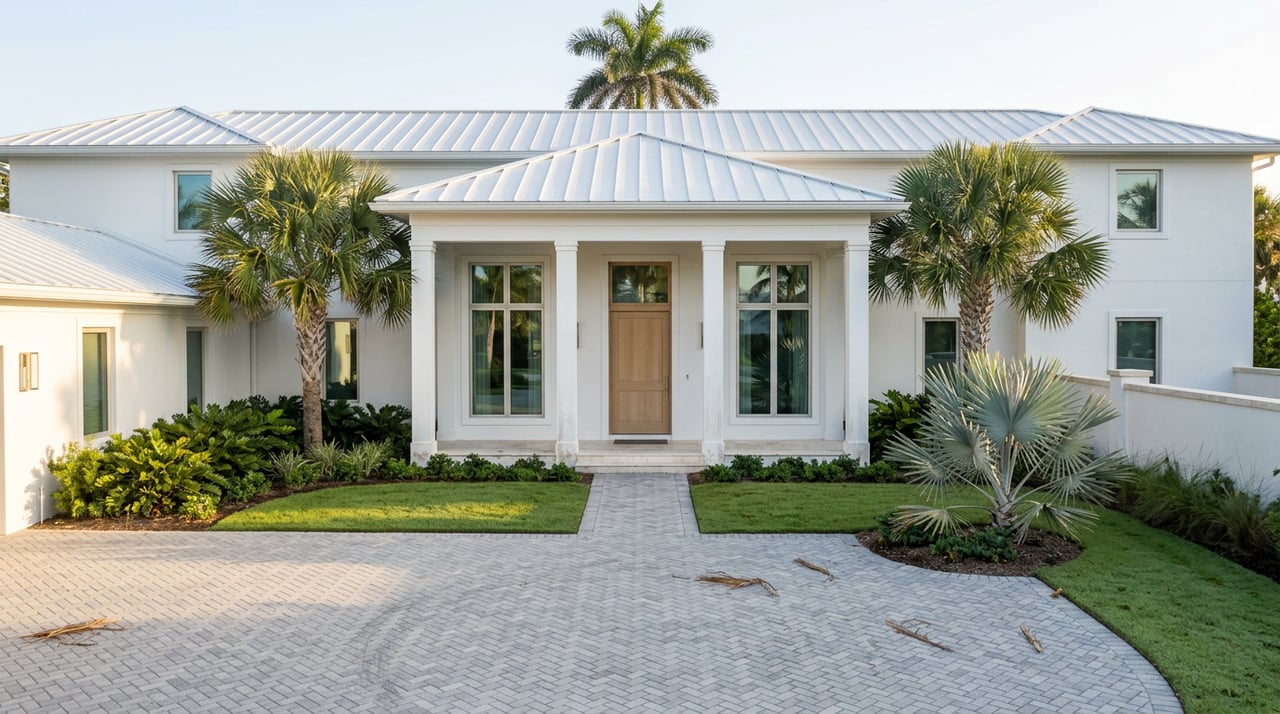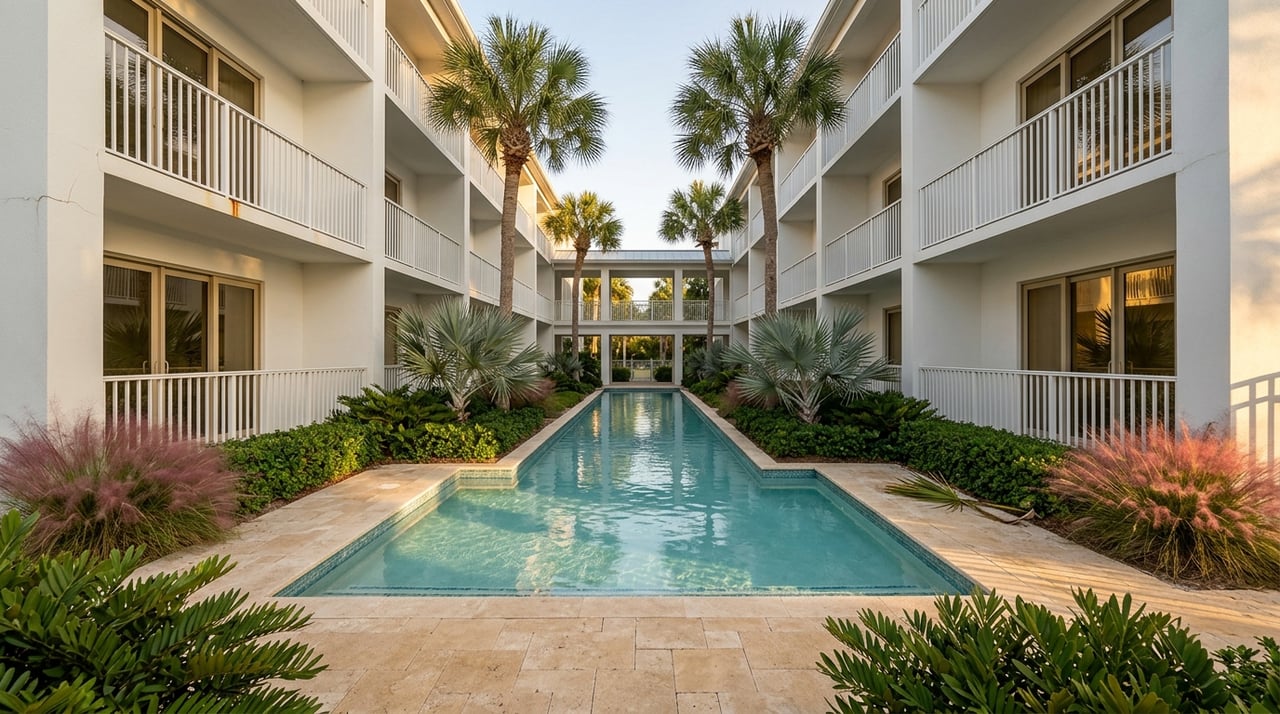
Drive south on A1A through Hutchinson Island and at some point, without a sign or a stoplight to mark it, the skyline changes. Mid-rise condo towers give way to buildings that top out at four stories. No high-rises. No mid-rises. Just low, wide buildings under an open sky.
Buyers touring the island often assume this is a style choice, the kind of aesthetic preference one HOA made and another didn't. It isn't. It's a county line, and it changes more than the view. It changes what you can build, what you'll pay to insure the place, and how exposed you are to Florida's newest condo reforms. If you're comparing listings on Hutchinson Island as if it's one market, you're comparing two regulatory environments wearing the same zip code.
The boundary you can't see from the road
Hutchinson Island isn't a single, uniform stretch of sand. It's cut by the Fort Pierce Inlet into North Hutchinson Island and South Hutchinson Island, and within South Hutchinson Island, a second line runs through it: the border between St. Lucie County and Martin County. North of that line, you're in St. Lucie County. South of it, unincorporated Martin County, running down to the St. Lucie Inlet near landmarks like the Elliott Museum and the House of Refuge at Gilbert's Bar, Martin County's oldest standing building and a National Register site since 1974.
The geography reads as continuous. The governance doesn't. Two counties, two comprehensive plans, two sets of rules about what gets built and how it gets taxed, both applying to the same barrier island.
What forty feet actually buys you
The most visible consequence of that line is the one you can see from a mile away. Martin County's comprehensive plan has capped building height on the island at four stories, or 40 feet, since 1984. St. Lucie County never adopted the same limit, which is why the oceanfront north of the line, around communities like Ocean Village, is lined with mid-rise luxury towers, while buildings on the Martin County side, like Sandpebble Beach Club and Hutchinson House, stay low.
That isn't just a planning footnote. It's a supply constraint with a price tag attached. New condo construction on the Martin County side of the island is genuinely scarce, limited by the height cap, by how little buildable land remains, and by the cost of building to modern coastal code at all. When new inventory does appear south of the line, it tends to draw real competition, because there's structurally so little of it. North of the line, where height isn't capped the same way, the supply story is different and the buildings are, on average, taller and newer.
Here's the practical shorthand:
| North of the line (St. Lucie County) | South of the line (Martin County) | |
|---|---|---|
| Height limit | No countywide 4-story cap | Capped at 4 stories / 40 feet since 1984 |
| Typical building stock | Mid-rise luxury towers | Low-rise buildings, no high-rises |
| New construction | More common | Extremely limited, land and code-constrained |
| Representative communities | Ocean Village and similar gated beachfront complexes | Sandpebble Beach Club, Hutchinson House, Sailfish Point |
Two units with the same square footage and the same view can sit on opposite sides of a line that has nothing to do with either building and everything to do with which government drew the map.
The insurance market split too
The height cap has a second-order effect that shows up on your annual bill rather than your view. Martin County's home insurance market has moved dramatically toward private carriers in the last two years. Citizens Property Insurance's personal residential policy count in Martin County fell from 8,770 policies as of March 2024 to 1,543 as of May 2026, a drop of roughly 82 percent, according to an independent insurance agency's review of Citizens' own county-level filings. That's not a coincidence layered on top of the height story. Lower, newer, better-hardened buildings are easier for private carriers to underwrite at competitive rates, which is part of why so many Martin County homeowners have moved off the state's insurer of last resort.
If you're comparing a unit in a low-rise Martin County building to a similarly priced unit in a taller St. Lucie County tower, ask your insurance agent to run both. The gap can be larger than the difference in HOA dues.
The reform that's reaching backward, on both sides of the line
The county line doesn't insulate anyone from Florida's post-Surfside condo reforms, and this is where the friction gets real for buyers close to writing an offer. Milestone inspections and Structural Integrity Reserve Studies are now standard requirements for condo buildings statewide, and on Hutchinson Island they're already producing HOA fee increases and special assessments in some associations, according to a 2026 buyer's guide to the island's condo market. Older buildings, on either side of the county line, are the ones most likely to be catching up on deferred reserve funding right now.
This is the single most transaction-relevant thing a buyer can check before submitting an offer on any Hutchinson Island condo, regardless of which county it sits in: the association's most recent milestone inspection report, its SIRS summary, and whether any special assessment is pending or has recently been levied. A building's monthly fee tells you almost nothing about its actual financial health until you've seen those documents.
The tax line inside the line
There's a smaller, quieter version of the same story on the tax side. When St. Lucie County set its fiscal year 2025 millage in July 2024, county budget staff walked commissioners through how the change would land differently depending on where a homeowner lived. Residents in most of the county saw one adjustment. Residents specifically on South Hutchinson Island saw a different one, because the island carries its own erosion control millage, a separate taxing line that funds beach management specific to barrier island properties and doesn't apply to mainland homeowners. On a $400,000 homesteaded home, the county's own math put the difference at a few dollars a year, not enough to change anyone's decision on its own. But it's a clean illustration of a pattern that repeats throughout this piece: the island is taxed, insured, and permitted as its own thing, layered underneath whichever county happens to claim that stretch of sand.
What the median price was hiding
Put the mechanism together and the recent price data on the island starts to read differently. Over the three months ending in May 2026, the South Hutchinson Island market showed a median sale price of $525,000, down 4.6 percent from the same period a year earlier, with the average time on market stretching to 108 days from 79 days the year before. Taken alone, that looks like softening demand.
Taken alongside everything above, it looks more like a market absorbing higher carrying costs at the exact moment supply is structurally frozen. Buyers are taking longer to commit because they're pricing in insurance quotes, HOA reserve requirements, and now a possible special assessment before they write an offer, not because interest in the island itself has cooled. The broader county's most recent published report, covering March 2026, showed St. Lucie County's overall single-family market sitting at 5.2 months of supply, down from 6.3 months a year prior and closer to balanced than most of South Florida, with 468 closings for the month and 12 of those above $1 million. That's a market with room to negotiate, not one in retreat. On an island where new construction is this scarce, longer days on market usually means buyers doing their homework, not buyers losing interest.
Before you write an offer on Hutchinson Island
- Confirm which side of the county line the property sits on and what that means for height, density, and future construction nearby.
- Request the association's most recent milestone inspection and Structural Integrity Reserve Study, and ask directly about any pending or recent special assessment.
- Get insurance quotes on the specific building, not a general island estimate. The gap between a private-carrier quote and a Citizens policy can be significant.
- Ask about the erosion control millage or any other barrier-island-specific taxing district that applies to the parcel.
A short FAQ
Does the four-story limit apply to the whole island? No. It's specific to the Martin County portion of South Hutchinson Island, adopted through that county's comprehensive plan in 1984. The St. Lucie County portion, and North Hutchinson Island in a different county entirely, aren't bound by the same rule.
Is the Martin County side always more expensive because of the height cap? Not automatically. Scarcity supports value over time, but individual building condition, reserve funding, and insurance costs can move the numbers in either direction on a given listing. That's exactly why the documents matter more than the assumption.
Where do I find which county a specific address falls in? County property appraiser records will confirm it parcel by parcel, and local organizations like the Hutchinson Island Preservation Initiative track the Martin County side's ongoing conversations about height limits, erosion, and taxation if you want the community context behind the rules.
Where this leaves you
A barrier island this narrow shouldn't feel like two markets, but on paper it is, and the paper is what determines your insurance bill, your tax line, and your building's next reserve study. If you're comparing units on Hutchinson Island, ask which county you're actually buying into before you ask about the view.
If you want a second set of eyes on a specific building's inspection history, reserve funding, or which side of the line it sits on, Susie Wilson Real Estate works this stretch of the Treasure Coast closely enough to know the difference. Request a Free Home Valuation & Consultation and we'll walk through what a specific address actually carries with it.