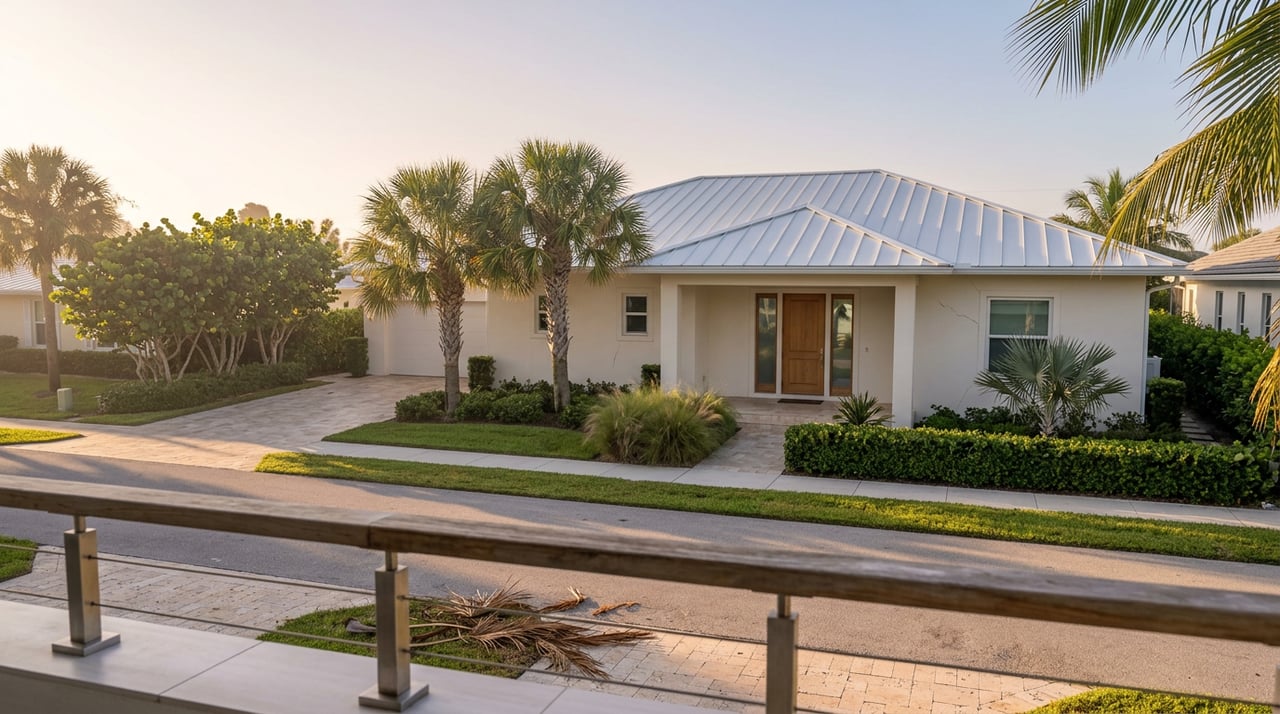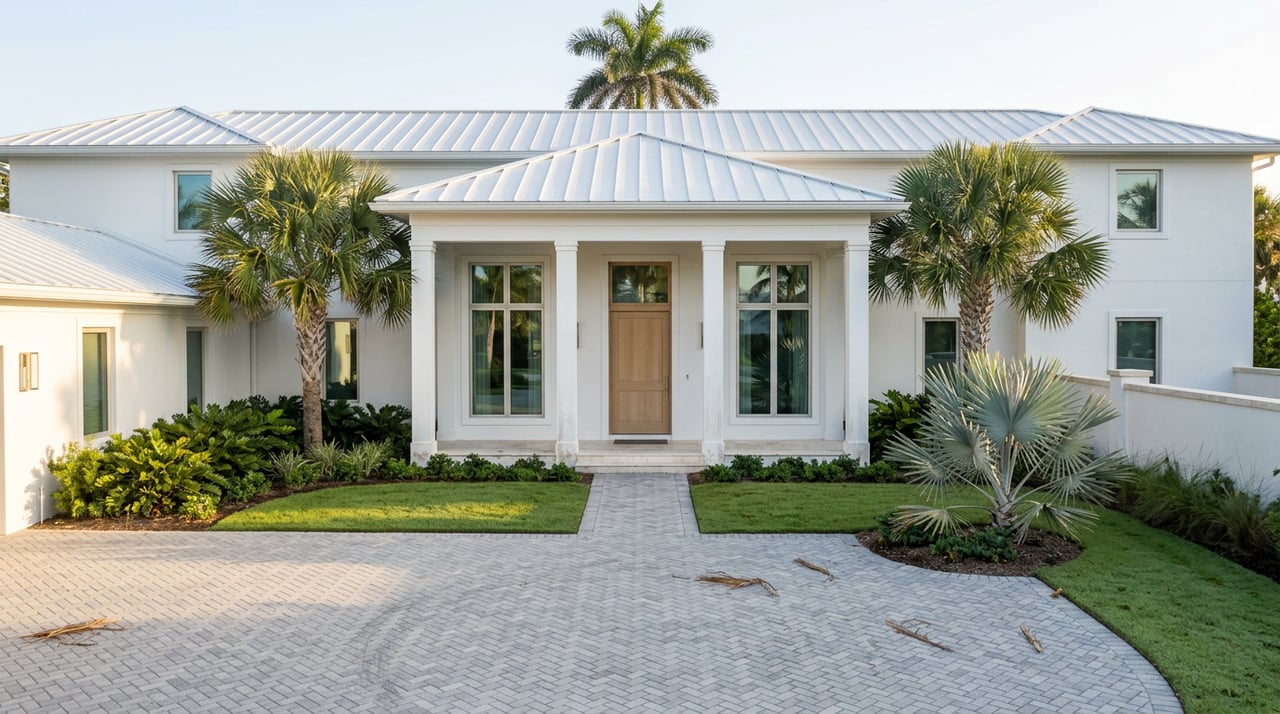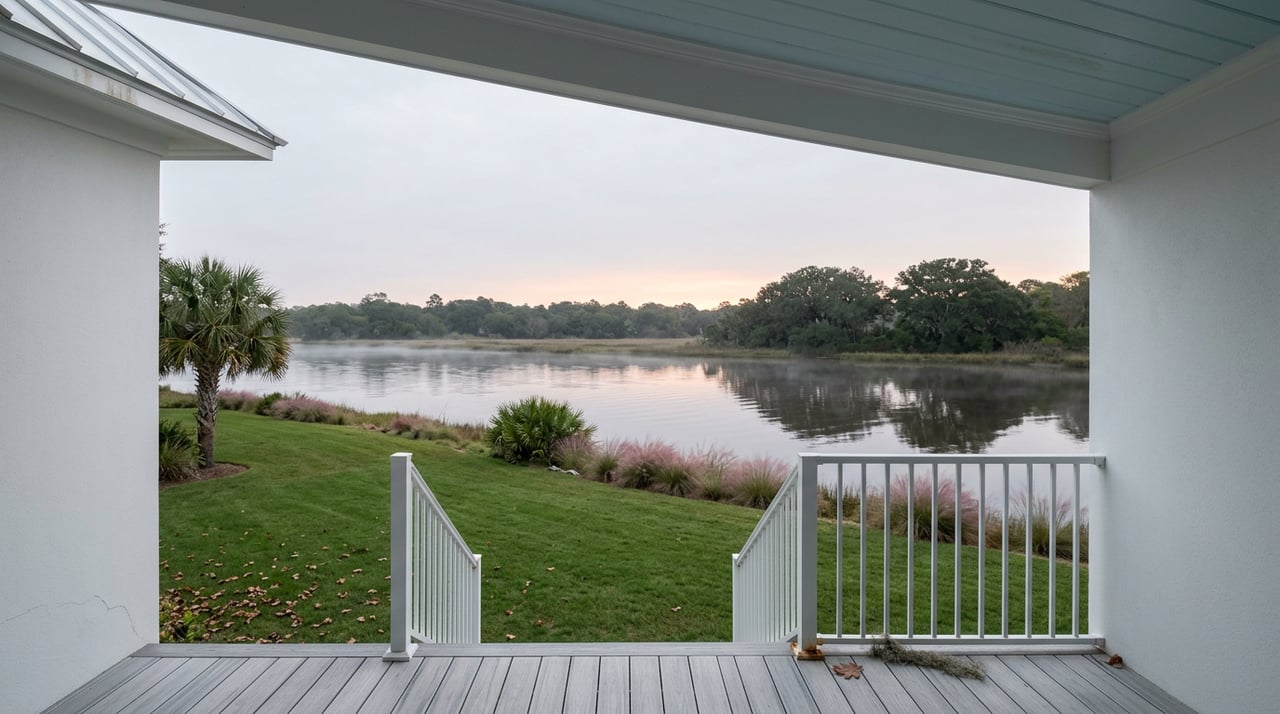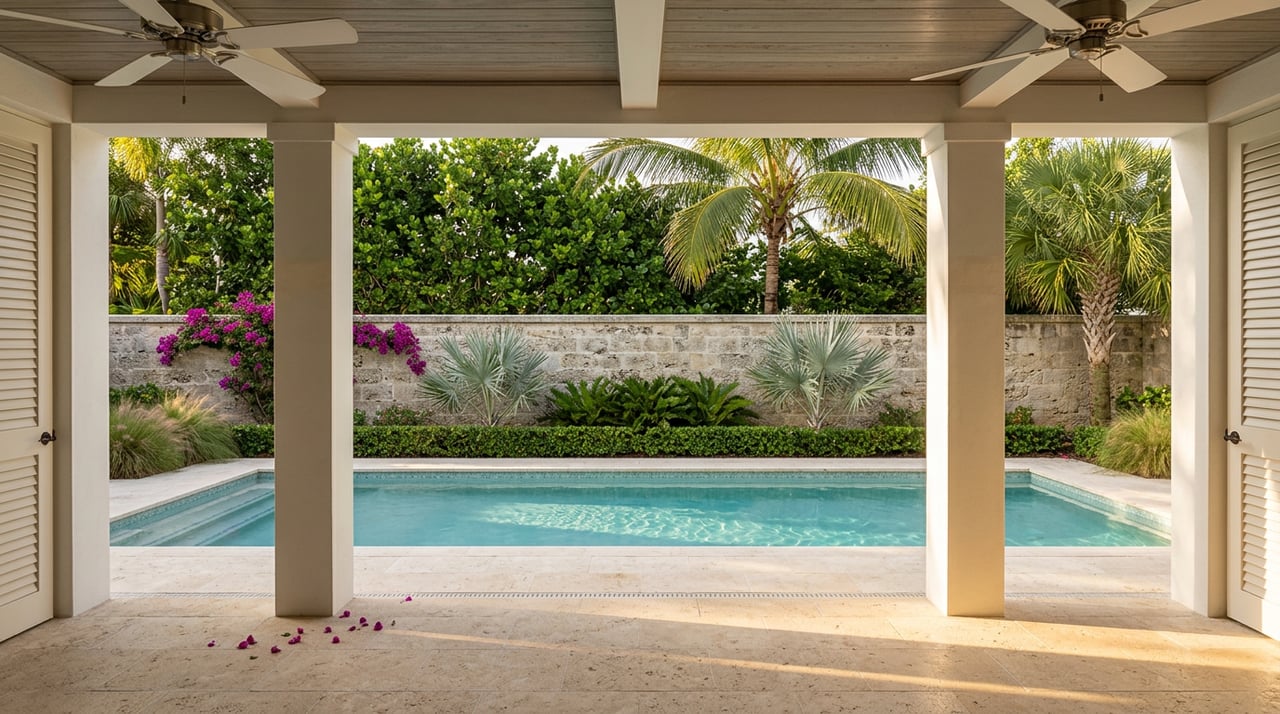
The membership roster thins in August. The Arnold Palmer course is quieter by mid-morning. The Beach Club dining room takes reservations without a wait list. If you have owned inside Orchid Island for even one season, you already know the surface version of this story. What is less obvious is that the club's original design intent, an ocean-to-river community wedged between two of Florida's most consequential wildlife preserves, only really resolves itself when the crowd goes home. The fence line that reads as security in February reads as ecology in August. The mile of private beach that reads as amenity reads as habitat. This is the season the neighborhood was built for, and most of it happens within a five-minute cart ride of your front door.
A quieter roster, a fuller property
Orchid Island is a debt-free 600-acre community of roughly 375 residences on the north end of the barrier island, incorporated in the Town of Orchid and bordered by both the Atlantic and the Indian River Lagoon. Mandatory membership means the ratio of member to amenity is fixed. What changes in summer is how many of those members are actually on property. The Pool Grille and Turtle Bar becomes the default lunch, the Seaside Lounge functions more like a member's living room, and the Dining Terrace fills only for the sunset seating. The 25 poolside cabanas, usually spoken for by January, are the kind of asset that reveals itself in July.
If your household joined during a peak window and has not yet spent a real August here, the second half of this post is a working itinerary. If you have, treat it as a checklist against what you have already made your own.
The refuge on the other side of the fence
The single fact most first-year owners underestimate is that Pelican Island National Wildlife Refuge is not a place you drive to. Part of it is your northern property line. The refuge grew from a five-acre rookery Theodore Roosevelt set aside in 1903 into a mosaic that now covers more than 5,400 acres of the Indian River Lagoon, and one of its buffer areas is a stretch of Orchid Island's own coastline south of Sebastian Inlet. The public trailhead complex, including the ADA-accessible Centennial Trail with its 500-foot boardwalk and observation tower, sits off Historic Jungle Trail a short distance north of the club's main gate.
Two things follow from that geography, and both matter more in the off-season than in the winter.
The first is paddling. The nearest public kayak launch is on the refuge road at 11820 Jungle Trail. Parking is limited by design. Members with their own hulls or the club's riverside launch can be on the water before the wind fills in around 10:30, which is exactly the window when the lagoon reads like glass and mangrove skippers work the shoreline. The U.S. Fish & Wildlife Service notes that fall through spring is the prime birding window for the famous white and brown pelican populations, so August paddling is less about the marquee species and more about the estuary itself: mullet running, an occasional roseate spoonbill in the shallows, and the quiet.
The second is etiquette. You cannot land on Pelican Island proper, and any spoil island with visible bird activity should be given wide berth. Sunscreen and repellent are not optional. Shade is scarce and biting insects run high in the interior trails through October.
The refuge exists because a boatbuilder named Paul Kroegel, working from a house on the Sebastian shore in the 1890s, decided the plume hunters had taken enough. Every plank on the Centennial Trail boardwalk lists a National Wildlife Refuge in the order it was established. The plank at the end says Pelican Island.
Owning here means the founding artifact of American conservation is a bike ride from your kitchen. That is a fact worth using in August, when nobody else is using it.
Chef Sozio's summer arithmetic
Executive Chef Chris Sozio's kitchen operates on a farm-to-beach premise that reads as marketing copy in a brochure and as arithmetic on a summer menu. The team sources produce and fish from independent Indian River and Okeechobee County growers, and Sozio grows some produce onsite. In the high season the menu absorbs specials well because the covers are consistent. In August the ratio of daily specials to club standards tilts the other direction. If you have not asked your server what came in that morning by name of farm, you are eating the winter menu in a July kitchen.
Three practical notes for the off-season:
- The Pool Grille and Turtle Bar takes a walk-up better than the main Dining Room in summer, and the flatbread and burger program is where the kitchen tests before it promotes.
- The Beach Club's expansive windows are aligned to the Atlantic, which means the tabletop light between 6:30 and 7:15 in August is closer to golden hour than sunset. Reserve accordingly.
- Wine list turnover is real. The by-the-glass program in August is not the January list.
The racquet complex you may not have played yet
The Racquet Sports Complex is the club's newest addition and, per the club's own material, the fastest-growing amenity by member participation. The footprint pairs eight Har-Tru tennis courts with pickleball courts, a basketball court, bocce lanes, and a croquet lawn. If your last serious court time on property was on the original tennis center, the complex is worth an unhurried visit. Summer clinics run when winter clinics cannot, courts book without a queue, and the pro staff has bandwidth for a full lesson rather than a fifteen-minute swap.
For members who play pickleball off property in Vero, the difference in August is that you can play here without the courtesy negotiations that come with a public venue.
The beach at nesting scale
The club's stretch of Atlantic runs a little over a mile. From May through October, that mile is also a working sea turtle nesting beach, and the interior lots inside the buffer land are part of what makes it viable. If you walk the beach at first light in August, you will see the previous night's crawls before the tide has finished editing them. Nest markers appear inside a day.
Two habits separate residents from guests during nesting season. One is lighting discipline on the oceanfront elevations, which the club and the Town of Orchid coordinate more tightly than most Vero addresses. The second is beach chair etiquette overnight: leave nothing on the sand after sunset. Both are enforceable, both are cultural, and both matter more in August than in February because August is peak.
The five-minute perimeter
Not every off-season evening lives inside the gate. The Environmental Learning Center on Wabasso Island, a 64-acre nonprofit campus at the western foot of the Wabasso Bridge, runs kayak and paddleboard rentals, a butterfly garden, aquariums totaling roughly 2,000 gallons, and a boat program that includes tours toward Pelican Island NWR. Details are at discoverelc.org. Across the causeway, Riverside Theatre's outdoor Loop concerts run Fridays and Saturdays from about 5:30 to 8:30 through the summer, and Ballet Vero Beach's collaboration with Riverside brings Dimensions Dance Theatre of Miami to the Waxlax Stage August 6 through 8. The Vero Beach Museum of Art and McKee Botanical Garden are offering complimentary admission to active-duty military families through September 7, which is worth passing along to visiting family.
Approximate driving times from the north gate, useful for planning:
| Destination | Drive time |
|---|---|
| Pelican Island NWR trailhead (Jungle Trail) | 5 minutes |
| Environmental Learning Center, Wabasso Island | 8 minutes |
| Sebastian Inlet State Park north side | 10 minutes |
| Riverside Theatre / Vero Beach Museum of Art | 20 minutes |
| Historic Jungle Trail, south end at Wabasso | 6 minutes |
The point of the table is not the individual entries. It is that the entries are all under a half hour. Very few private club communities in Florida sit inside a ring like this.
Why this matters if this is your home
The instinctive reading of an off-season is a subtraction. Fewer members, fewer reservations, fewer tee times booked. The truer reading at Orchid Island is that the property was designed to be at its best when the roster is thin. The Palmer course, the Racquet Sports Complex, the Beach Club, and the mile of nesting beach were built to be used, not queued. The refuge boundary, which is what makes the setting genuinely rare, is a summer story more than a winter one. If you spend August here with intent, you own the neighborhood the brochure was written about.
If you are considering how a home in Orchid Island might work for a full four-season life, or you already own here and want a candid conversation about presentation, staging, or seasonal rental strategy, Susie Wilson Real Estate works this stretch of the barrier island every week. Request a Free Home Valuation & Consultation when the time is right.